Applaud CPDD effort in setting up this site for resources especially on the use of Arcgis.
https://sites.google.com/moe.edu.sg/cpddgis/home?authuser=1
Map library https://docs.google.com/spreadsheets/d/1Ul0Zbhm6_UopQqhb6e9qXx6f_Ly33tHuXTa7To1PH08/edit?usp=drivesdk
Is it dangerous living near a volcano
https://moe-edugis.maps.arcgis.com/apps/View/index.html?appid=a3b5a5f369b54443b0630638ed674928
Where is all the water on the planet?
https://moe-edugis.maps.arcgis.com/apps/View/index.html?appid=9951616e12f043bf9518c745e9cf0be9
Friday, March 1, 2019
Friday, February 22, 2019
Coastal studies in Sentosa
- A virtual fieldwork via a video captured by drone on Tanjong Rimau and rocks on the island in a workshop conducted by Sentosa Nature Discovery followed by a walk on Imbiah trail. Saw the Imbiah falls along the way. Thankful that we had a very enriching experience with our guide, Tammy, from SND.


The two programmes which we can embark on in Sentosa for Geography

Differential erosion - conglomerates and sandstones. Did not cross my mind to show the students the different types of rocks to show them that. Time to dig out my old collection! Indeed students can make connection to their learning if they can see it with their own eyes.

Used to bring the students for fieldwork at this part of Sentosa in the 90s. Just realized it is called Tanjong Rimau. The observation of fissures, the notch, the caves on the cliff, and the action of plant roots on weathering. The measurement of the height of the cliff and the gradient of the transect along the shore platform. Had a very good mentor, Alice, back in the 90s.


Stephanie from Pierce Secondary, June, Tammy from SND, myself, Mdm Rahimah, Mdm Tian and Mr Arman


Where the rock beach is - didn't know there are corals too. Used to bring the students to the coralarium which had made way for the golf course. Students love the touch pool and learned more about the fringing reef.

Kapok tree

Kapok fibre from the seeds of the Kapok tree used for e.g. stuffing jackets


Nice trial with information on Forest

Imbiah trial from SND to Siloso Beach

A shelter near Silo Beach

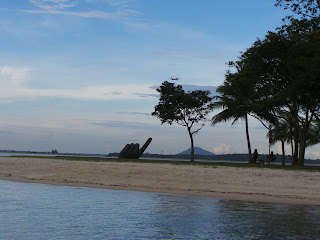
Siloso beach - a study of soft engineering - beach nourishment

floating platform

sea grass and algae

extremely scorching

rock armour protecting the beach from erosion

seawall protecting the coast

Wave house - an attraction for tourists

A lifeguard ensuring the beach goers are safe

A tour of Siloso beach by Tammy

Safe to swim!

Actually the waves are quite strong. Look at the swash

Tourists swimming in the near water, a girl building sand castle and some boys playing volley ball.

This was where the old coastline was with the spring water

A 360 view of Siloso Beach
Saturday, October 27, 2018
Collaboration using Skype
Wow love this sharing by Michael in the SG Learning Designer circle. Indeed the joy of learning geography is beyond the boundary of the classroom. And nothing beats the satisfaction in ownership of learning. Love how the kids asked the questions in true geographers' eyes... Does the Andes run across the country? Does your country experience dry weather? And not questions like does your country starts with X etc
Tuesday, May 22, 2018
Pulau Ubin Micro-Grid Test Bed
Part of Geog symposium 2018 - #letstalkgeog Geography Symposium
Learned a lot on Singapore Energy from the LJ today.
Singapore was first lighted up in 1906 from the first power station, the Maxkenzie Road Power Station. It used coal then - a fossil fuel which emitted 40% more CO2 than the natural gas which we are using now.
There was a severe blackout on 29 June 2004 due to the disruption of gas supply from Indonesia. This prompted the government to ramp up Singapore's energy security.
We have been teaching the students about the fuel switch under the 2012 Singapore Green Plan - that natural gas emits 30% less CO2 compared to burning oil for energy. What I had learned for this LJ which I must say is a great add on is the opening of Singapore's first LNG terminal in 2013. With liquefied natural gas there is decrease reliance on piped natural gas. Today 95% of our energy is from natural gas - a mixture of piped and liquefied natural gas.
When looking at energy options, the 3 factors are:
1. Price competitiveness
2. Sustainability
3. Reliability (24/7) and security.
Also learned something interesting - that there is a storage of chilled water below the Marina bay sand area which provides energy to the district.

Micro-grid test bed at Pulau Ubin:


 Arriving at the jetty by bum boat from Changi Point Ferry Terminal - $3 per pax and they will wait for 12 pax before they set off.




Main source of energy on the island
Solar panel
Diesel
Energy storage banks
Phase 1
Test bed
Intermittency dip with high cloud clover, back up by batteries
Last resort Hybrid diesel and biomass
Cables underground all shops and houses w smart meter but some still on generator
Ms koh - the owner of a bicycle shop, saved electricity bill from 800 plus to 300 plus. Price competitiveness and also greener then using diesel
Every household or shop has a smart meter.
Taping on solar reduces electricity demand
Day usage is higher (industrial)
Renewable and no need to burn fossil fuel
Batteries -3 types
Hanging and floating solar panels
Now 95% is from natural gas.
Solar, biomass
More is on solar
Micro grid is pioneered by EMA
Questions were raised on alternative energy sources for Singapore.
Some reservoirs have floating solar panels. Biggest at Tengah reservoir
New HDB flats ready with solar panels
Innova clean energy
Tapping on solar
Island.. pulau semakau explore wind energy
West part of island tapping on turbine
Learned a lot on Singapore Energy from the LJ today.
Singapore was first lighted up in 1906 from the first power station, the Maxkenzie Road Power Station. It used coal then - a fossil fuel which emitted 40% more CO2 than the natural gas which we are using now.
There was a severe blackout on 29 June 2004 due to the disruption of gas supply from Indonesia. This prompted the government to ramp up Singapore's energy security.
We have been teaching the students about the fuel switch under the 2012 Singapore Green Plan - that natural gas emits 30% less CO2 compared to burning oil for energy. What I had learned for this LJ which I must say is a great add on is the opening of Singapore's first LNG terminal in 2013. With liquefied natural gas there is decrease reliance on piped natural gas. Today 95% of our energy is from natural gas - a mixture of piped and liquefied natural gas.
When looking at energy options, the 3 factors are:
1. Price competitiveness
2. Sustainability
3. Reliability (24/7) and security.
Also learned something interesting - that there is a storage of chilled water below the Marina bay sand area which provides energy to the district.

Micro-grid test bed at Pulau Ubin:


So awed by the rocks near the jetty


A map of the island near the jetty

The main purpose of our visit to look at the micro grid test bed on how solar energy is tapped on the island. This is the learning journey which is part of Geography Symposium 2018

Rows of bicycle rental shops

There is also a taxi service near the jetty.

The island has attracted quite a number of tourists


A few restaurants on the island


By using the new energy instead of generator, the owner Ms Koh electricity bill is reduced from $800 plus to $300 plus a month

The familiar stage which I saw decades ago


The noisy generator which is still being used by the residents - though it is labelled ultra-silent. There are around 100 plus residents on the island who have benefitted greatly from the micro-grid bed test. They have installed SMART meter.


the solar panels on the roof top slightly tilts downwards towards the east. This maximise the absorption of solar and also allow the water to drain off the roof

The geography teachers' learning journey to Pulau Ubin micro-grid test bed.

The geography teachers also enjoyed a game of "monopoly" with questions or tasks related to energy.

Can you see the solar panel behind the papaya trees?


Love the aerial roots of the mangrove


So picturesque


Passed by the Changi Spit


Many fish farms near the island


As it is so near to the airport, we saw quite a number of planes flew by

Beautiful houses protected by the sea wall

drainage into the sea

Look at the view - captivating right?


More photos here:
https://www.facebook.com/
Main source of energy on the island
Solar panel
Diesel
Energy storage banks
Phase 1
Test bed
Intermittency dip with high cloud clover, back up by batteries
Last resort Hybrid diesel and biomass
Cables underground all shops and houses w smart meter but some still on generator
Every household or shop has a smart meter.
Taping on solar reduces electricity demand
Day usage is higher (industrial)
Renewable and no need to burn fossil fuel
Batteries -3 types
- Lithium
- Zinc air sensitive to humidity
- Sodium ion
Hanging and floating solar panels
Now 95% is from natural gas.
Solar, biomass
More is on solar
Micro grid is pioneered by EMA
Questions were raised on alternative energy sources for Singapore.
Some reservoirs have floating solar panels. Biggest at Tengah reservoir
New HDB flats ready with solar panels
Innova clean energy
Tapping on solar
Island.. pulau semakau explore wind energy
West part of island tapping on turbine
Subscribe to:
Posts (Atom)