Interesting way of introducing different food consumption patterns in the world using AR in cospaces - https://cospaces.io/edu/projects.html
A lesson plan is also included on the link above or you can download from the link below:
https://cospaces.io/edu/vr-plate-lesson-plan.pdf
as suggested in the lesson plan - it would be good to get the students to research into where the ingredients of the food they are eating is from - that will relate to food production. They will also need to relate to the accessibility of food and how transport and storage of food plays a part.
Showing posts with label Geography of Food. Show all posts
Friday, November 15, 2019
Thursday, November 14, 2019
Full Geography seminar and talk by SFA
Attended the full Geog seminar on 14 Nov.
Madeline shared on the food video project w her students refer to video and resource on site.
Introducing the new geog curriculum concept.
Display by SFA

The Singapore food story by Mrs Jocelyn Ng
SFA (Singapore food agency) ensure supply of food and food security. It was combined from AVA and NEA and HSA (health science authority) food testing labs.
Urbanisation, competing land use, lack of farm workers, increasing population growth as well as competing use of energy and water w agricultural land use can all pose challenges to food security.
Food security risk as food contamination can occur from production to factory processing to hawkers.
What is food security?
only 1% of Singapore's land is used for agriculture.
In 1999 there was a virus outbreak which disrupted supply of fresh pork
2003 SARS outbreak Pasir Panjang wholesale Centre some workers were quarantined so vegetable supply disrupted. closed for 15 days.
Bird flu in China from end of 2013 to 2014 near CNY.
Prices go up when food supply disrupted disruption of onion supply from India. government ban as insufficient supply due to delayed monsoon, flood etc onion from egypt, turkey, china etc tough for bangladesh
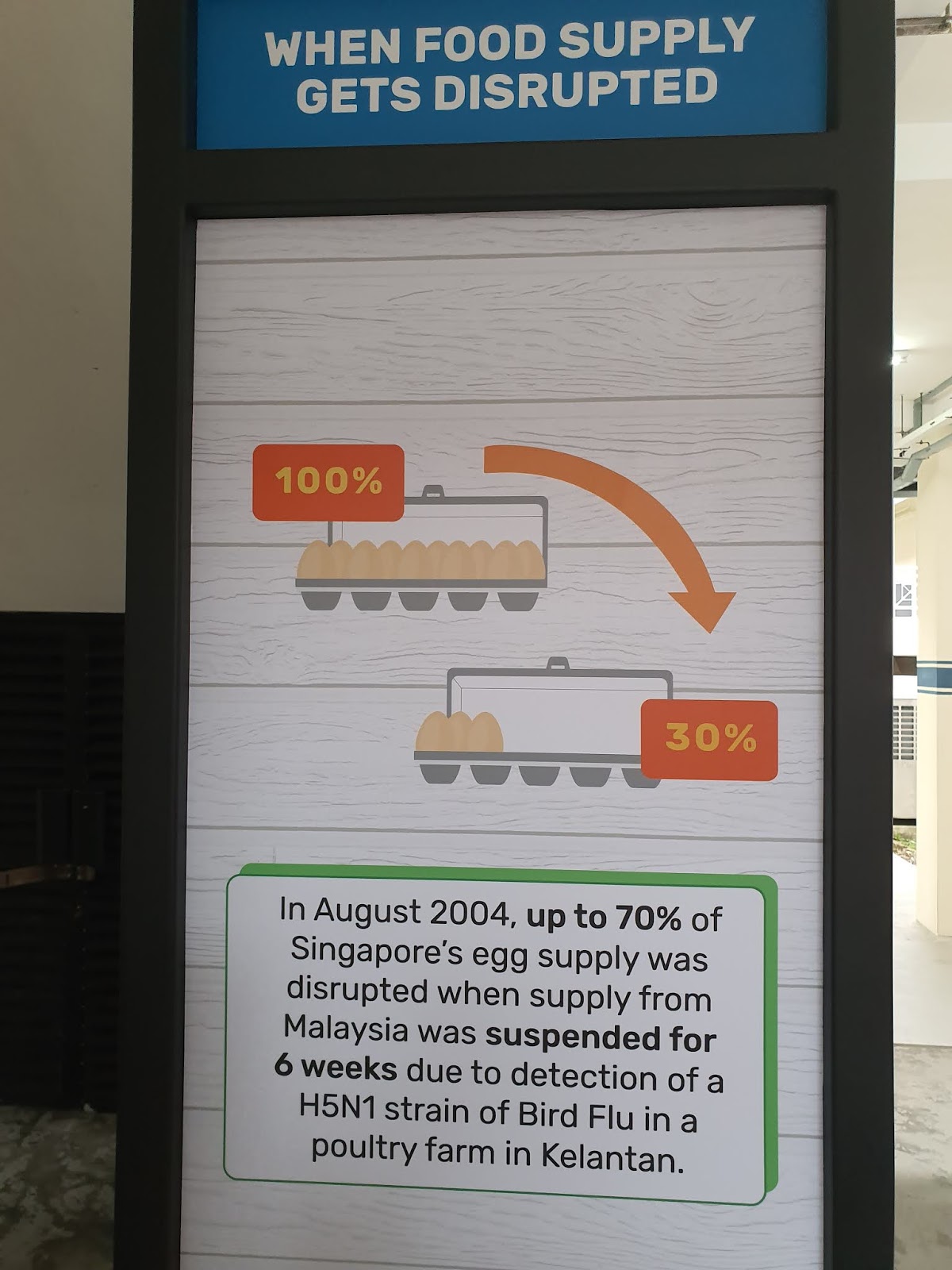
Malaysia prohibited export fish and eggs jan to feb in 2018.
3 Food baskets
1.Diversify import sources. reduce risk of reliance on any one supply source e.g. eggs from Ukarine, New Zealand majority from Malaysia andSingapore farm
2. Grow local. helps mitigate our reliance on imports and serves as a buffer 0. grow overseas. support our companies to expand and grow overseas   e.g. Apple from South Africa  use less to produce more   ambitious target 20 to 30% not possible to be 100% self sufficient. Back to planning ~agricultural land cluster at yio chu kang coastal lim chu kang, changi. Citiponics on roof top of multi storey carpark @AMK brand leaf well commercial farm utilizing space Elderly from nearby home only work in early hour of morning. transplanting or harvesting involve the community. Certain portion donated to the home sky green vertical farms. sunlight indoor controlled environment. water, nutrients etc 
St John island R&D sea bass 20% bigger
Meat based diet requires a lot of land and cattle release a lot of methane, a greenhouse gas Science base using technology to help grow plants and fish  grow overseas  how can we support? 
3. Growing overseas. Singapore help in the setup pig farms in China Prime mahkota brand fr China, local fish farm
Q&A
4th basket national stockpile?
Singapore works with ASEAN countries controls of export or imports e.g. FAO representation diff guidelines for diff countries e.g. some relevant only to EU. NTUC fairprice carry the largest local grown food widest vegetable range comcrop, panasonic salad, mushroom, fish from Apollo. Pasar NTUC housebrand can be fr Malaysia etc which they would put the country of origin how is local farmer supported in terms of price? freshness, sustainability (support local), safe as random check by SFA.
Challenges in relocating the farms e.g. MINDEF taking back the land, some tradeoff when new land is released it is based on best concept rather than just price if the land is not as productive and lease is up, it will be given to a more productive purpose agricultural productivity fund. Farmer can apply the grant to invest in equipment or technology which can increase productivity 50 to 60% e.g. sensor to monitoring , cut on need for 24 hour manpower
Madeline shared on the food video project w her students refer to video and resource on site.
Introducing the new geog curriculum concept.
Display by SFA
SFA (Singapore food agency) ensure supply of food and food security. It was combined from AVA and NEA and HSA (health science authority) food testing labs.
Urbanisation, competing land use, lack of farm workers, increasing population growth as well as competing use of energy and water w agricultural land use can all pose challenges to food security.
Food security risk as food contamination can occur from production to factory processing to hawkers.
What is food security?
only 1% of Singapore's land is used for agriculture.
In 1999 there was a virus outbreak which disrupted supply of fresh pork
2003 SARS outbreak Pasir Panjang wholesale Centre some workers were quarantined so vegetable supply disrupted. closed for 15 days.
Bird flu in China from end of 2013 to 2014 near CNY.
Prices go up when food supply disrupted disruption of onion supply from India. government ban as insufficient supply due to delayed monsoon, flood etc onion from egypt, turkey, china etc tough for bangladesh
Malaysia prohibited export fish and eggs jan to feb in 2018.
3 Food baskets
1.Diversify import sources. reduce risk of reliance on any one supply source e.g. eggs from Ukarine, New Zealand majority from Malaysia andSingapore farm
2. Grow local. helps mitigate our reliance on imports and serves as a buffer 0. grow overseas. support our companies to expand and grow overseas   e.g. Apple from South Africa  use less to produce more   ambitious target 20 to 30% not possible to be 100% self sufficient. Back to planning ~agricultural land cluster at yio chu kang coastal lim chu kang, changi. Citiponics on roof top of multi storey carpark @AMK brand leaf well commercial farm utilizing space Elderly from nearby home only work in early hour of morning. transplanting or harvesting involve the community. Certain portion donated to the home sky green vertical farms. sunlight indoor controlled environment. water, nutrients etc 
St John island R&D sea bass 20% bigger
Meat based diet requires a lot of land and cattle release a lot of methane, a greenhouse gas Science base using technology to help grow plants and fish  grow overseas  how can we support? 
3. Growing overseas. Singapore help in the setup pig farms in China Prime mahkota brand fr China, local fish farm
Q&A
4th basket national stockpile?
Singapore works with ASEAN countries controls of export or imports e.g. FAO representation diff guidelines for diff countries e.g. some relevant only to EU. NTUC fairprice carry the largest local grown food widest vegetable range comcrop, panasonic salad, mushroom, fish from Apollo. Pasar NTUC housebrand can be fr Malaysia etc which they would put the country of origin how is local farmer supported in terms of price? freshness, sustainability (support local), safe as random check by SFA.
Challenges in relocating the farms e.g. MINDEF taking back the land, some tradeoff when new land is released it is based on best concept rather than just price if the land is not as productive and lease is up, it will be given to a more productive purpose agricultural productivity fund. Farmer can apply the grant to invest in equipment or technology which can increase productivity 50 to 60% e.g. sensor to monitoring , cut on need for 24 hour manpower
Panasonic Farm visit
Visited the Panasonic Factory Farm organised by SFA and Geog unit after the Full Geography Seminar.
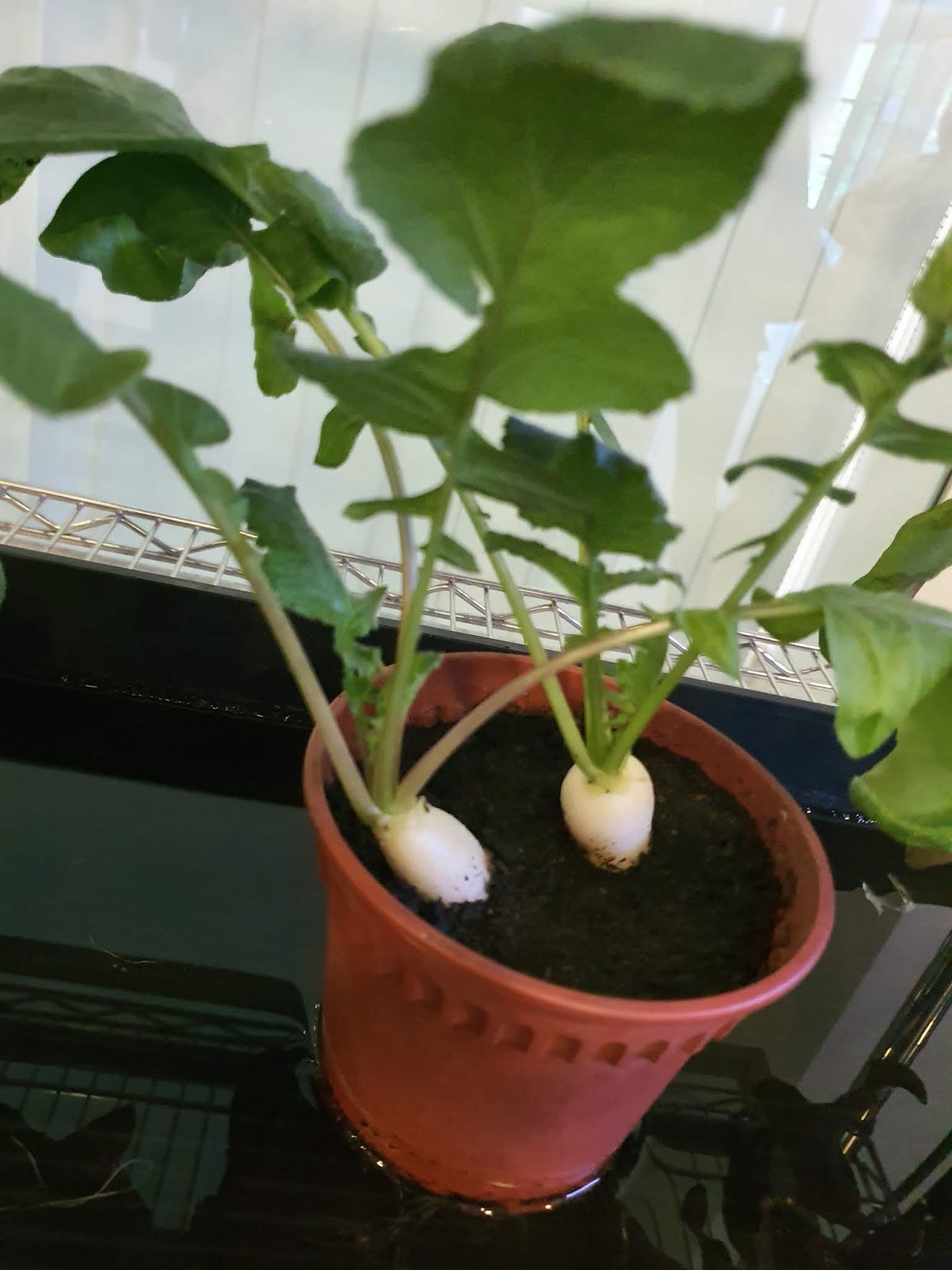
It is the 1st farm which has both the farm license and food processing licence. We were shown a video on the indoor farm as well as how to use a veggie life cultivation kit and reminded not to put the seeds too deep into the soil, not more than 10 cm. It will take around 35 days to mature as compared to the traditional farms' which take a longer growing period of 6 weeks to 2 months. If school wants can contact by SFA online at $10 per participant. Each participant will be given the veggie life cultivation kit and a bowl of salad. I must really say the salad was so crunchy and delicious as it's fresh from the farm! More exotic japanese plants were grown in the factory farm which is 30% cheaper than imported. Our guide explained to us why red and blue lights are used. For photosynthesis, red light control a parameter and blue another. The amount of light used is customised to the plant grown. There is also control of water and nutrient as well as enhanced co2. Same music is played (mainly classical) to encourage plant growth. Air flow/wind is used to toughen the plant.
Some are planted in peat from European countries
And some using Hydroponics. Some are hybrids. We
We saw from the monitor the prep room, harvesting room and Processing room.
With the controlled production, there is a stable supply and there is quality assurance and no pesticides is used as no pest can enter. It has a Shorter lead time and is not at mercy of adverse weather and not affected by price fluctuations.
There is also increase productivity with the use of automation for example, 11 instead of 27 labour is needed.
Though investment cost is higher for hydroponics, operation cost (less labour) is lower. Hydroponics technology is more matured compared to aeroponics and aquaponics. Moreover, Aquaponics has high risk.
Panasonic sees food production as part of corporate social responsibilty contributing to food security. Our guide mentioned that the biggest challenge is consumer education as it is more costly for indoor produce.
In Singapore, 90% of the vegetgables are imported as the vegetables are cheaper due to economies of scale. For local produce, other than government support, consumer support is definitely needed as when there is more demand and more are produced, the cost can be reduced.
https://www.panasonic.com/sg/corporate/news/article/singaporeindoorfarm.html
Friday, June 29, 2012
Geography of Food Seminar
Attended the seminar by GTA today http://gtasg.webnode.com/
Very informative and interesting presentation - must say we learned a lot from the 3 speakers.
I must say we learned much about what the AVA is doing to ensure food safety and security in Singapore from Mrs Tan-Low Lai Kim.
I was surprised to learn that the consumption of whole fish is actually declining in Singapore. It seems that the youngsters prefer fish in the form of nuggets or fillet as they don't like whole fish with fish bones.
She also highlighted interesting facts such how the chicken rice vendors came to them for help when live chicken imports from Malaysia was banned in 2003 due to the avian flu outbreak. Consumption decreased rapidly then as compared to the outbreak in 2006. The AVA had improved the situation by banning by zones in a country rather than the whole country e.g chicken was supplied from Johor when there was an outbreak in Perak.
Being a country dependent on imports, food security often pose a problem. Emerging economies with increasing affluence might export less as their people become more affluent.
There is also a challenge in declining global food supply with declinging agricultural productivity, competition for essential resoueces such as water, arable land, labour and investment as well as diversion of food crops for biofuel production.
Of course other food security challenges include climatic change, outbreaks, natural disasters, political uncertainties, restrictive trade etc.
Key strategies which Singapore deployed:
1. diversification of food sources
2. stockpiking of essential food stocks
3. enhancing local production through small local farming
$10 million food fund introduced in 2009 - R&D in farming techniques e.g. fish breeding, vertical farming, seed banking
4. Promotion of food substitudes
It really makes us ponder about the food we are eating today. There is quite a good documentary on CNA tomorrow (10th April 2011) at 7pm - a preview of the show below:
No wonder one of the speakers, Dr George Jacobs, became a vegetarian. It seems that more people are becoming vegetarian not because of religion but rather due to health, environment and kindness (towards animals) concerns. It is a fact that much food has gone into feeding animals rather than hungry people - I suppose that's why there is a movement to be vegetarian once a week - www.facebook.com/veggiethursdaysg
The last speaker, Dr Pow Choon Piew, talk about the Hungry cities.
click here to see the no. of hungry people in the world
http://www.worldbank.org/foodcrisis/
imagine a billion people still hungry in the world
Subscribe to:
Posts (Atom)